Editor's Pick Topical
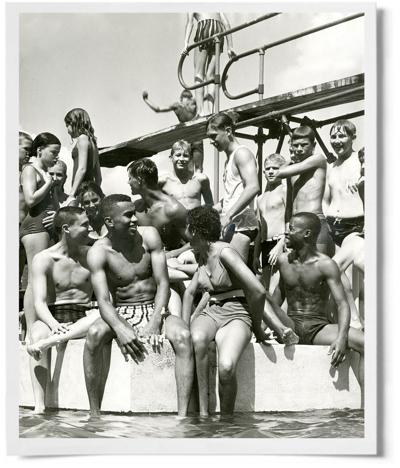
Back in the day, July 26, 1963: Ten black youths swim for the first time in Peony Park's pool
- Omaha World-Herald
- Updated May 23, 2023

This photo was taken on the second day that Black people were admitted to the Peony Park pool. On July 26, 1963, Peony Park, which had been strictly segregated, allowed Black people to swim in the pool for the first time. Herb Rhodes, second from left, was among the first Black people to swim at the pool that first weekend. He is shown here at the diving board dock with, from left, F.J. Pepper of Omaha Urban League, Betty Jo Moreland and Dale Anders.
THE WORLD-HERALD
Prefer us on Google Learn More
Omaha World-Herald
The stories are distinct, but their origin is the same: a neighborhood so vibrant, so unified that individual accomplishments and devastations touched every house from Tech High to Kountze Park. A neighborhood where, depending on the night, they might see Martin Luther King Jr., Malcolm X, Ray Charles, James Brown, Joe Louis, Jesse Owens or Jackie Robinson – just walking down 24th Street. A neighborhood despite its humble size and remote location in middle America, became a progressive beacon in the national protest movement, recognized by would-be presidents and would-be revolutionaries.
Peony Park, an Omaha amusement park that closed in the 1990s, was strictly segregated until July 26, 1963. Black people were allowed in parts of the park but were banned from the pool.
However, 58 years ago today, 10 members of the NAACP Youth Council swam briefly in the pool and celebrated a significant victory in Omaha's early march toward racial equality.
A lifeguard "escorted" the group of teens into the pool.
Previously, Black people had tried without success to fight Peony Park's ban.
One month before the July 26 swim, two Black Offutt Air Force Base airmen had initiated anti-discrimination legal action against Peony Park after they were denied entrance to the pool during an outing with white airmen. The City Prosecutor's Office filed a civil rights charge against the park.
People are also reading…
- Huskers beat up after Oregon: Broken bones and season-ending injury
- Lincoln teen killed in crash at 84th and O streets
- Pius X community mourns after Lincoln teen dies in O Street crash
- Man found dead west of Elkhorn identified by Douglas County Sheriff's Office
- Ricketts defends pardon of man convicted of sexually assaulting estranged wife
- Nebraska father sues HHS after agency quotes $1M, 50 years for public records
- Texas murder-suicide suspect who killed Doane student also attended Crete school
- Why an NBA great is wading into the Lancaster County sheriff's race
- Doane student killed in Texas in attempted murder-suicide
- Massive elk killed, vehicle totaled in unusual southwest Lincoln crash
- Just: We are all tired. And the whys keep coming in Nebraska's latest soul-crusher
- 'Much respect to him': Nebraska reunion with Dylan Raiola short-lived — and painful
- Nebraska high school football rankings: See who rose and fell after Week 8
- Blackout at night: Kickoff time set for Washington-Nebraska Halloween game
- Lincoln man enters plea in crash that killed 86-year-old Waverly man
One year after James Scurlock was killed, Omaha still coming to grips with aftermath
Herb Rhodes and fellow members of the NAACP Youth Council challenged the racist ban earlier in July 1963 by trying to enter the pool. When they were denied entry, they and carloads of other young people peacefully stayed outside the gates, causing a long backup of would-be swimmers on a simmering summer day.
Then-Gov. Frank Morrison said the amusement park appeared to be violating anti-discrimination laws. Rather than let Black people in, Peony Park officials closed the pool as demonstrators chanted outside.
Peony Park tried to get around the law by reopening as a private pool but eventually conceded and began admitting Black people. Rhodes was among the first Blacks to enter the once-segregated waters. He went back only once after that, but his children could go there as they wished in the future.
Bob Paris was a 22-year-old ex-Marine who had recently returned to Omaha. He worked full time at the Veterans Hospital to save money for college and helped with the youth council.
Over 150 Omaha business leaders vow to address inequities stemming from systemic racism
Paris said the incident involving the Offutt Air Force Base airmen and others solidified the resolve of youth council members.
"It wasn't about swimming in the pool," Paris said. "It was about one thing: denying us access."
Integrating Peony Park's pool was the young people's contribution. Their success rippled across the city and splashed through an unspoken but ever-present barrier that separated Black people from white people.
Sen. Justin Wayne: Juneteenth a reminder that fight for equality is ongoing
Being Black in Lincoln: Valenti works to educate, inspire Lincoln youth
Historical marker to be unveiled Friday at Omaha site where Will Brown was lynched in 1919
Photos: Peony Park swimming pool through the years
1932 PHOTO: The Peony Park swimming pool.
MIC-KEL PHOTO CO.
1950 PHOTO: Jim Schwertley watches the water as a lifeguard at the Peony Park swimming pool.
ROBERT PASKACH, THE WORLD-HERALD
1960 PHOTO: Former Omaha swimming instructor Bill O'Hearn and several of his former students at a 10-year reunion of the Old Peony Park Swim Club, then known as the Fehrs Swim Club. Attending were Judy Macy Betterndorf; Patti Dwyer Karkreader; Janet Vincent O'Donnell; Bobbie Henderson Powell; Kay McCabe; Roberta Kiddoo; Carol Powers; Sharon McCoy; Theresa, Martha, and Colleen Werve; and Edalou Hastings.
ED RATH, THE WORLD-HERALD
1964 PHOTO: Herb Rhodes ran track for then-Omaha University, now known as the University of Nebraska at Omaha. He mainly ran the 880, but at one time held the mile record at Omaha U. Rhodes graduated with a bachelor's degree in history in 1965. In the summer of 1963, Rhodes was among a group of young Black people who challenged racial segregation at the Peony Park pool.
THE WORLD-HERALD
1968 PHOTO: Peony Park was a magnet for teens on hot days. The park's famous swimming pool was built over "a huge underground lake," according to Joseph Malec, Sr. On especially hot days, cold water from adjacent wells was pumped into the pool to lower the temperature.
ROBERT PASKACH, THE WORLD-HERALD
1968 PHOTO: John Beasley, left, and Dale Anders. Anders was one of 10 Black youths to swim for the first time in the Peony Park swimming pool in July 1963.
THE WORLD-HERALD
1969 PHOTO: People wait in line for the slide at the Peony Park swimming pool.
PHIL JOHNSON, THE WORLD-HERALD
1987 PHOTO: Omahan Mary Lynn Riley enjoys a cool, swirling ride on the waterslide at Peony Park.
CHRIS YOUNG, THE WORLD-HERALD
1990 PHOTO: Peony Park's speed slides had drops of about three stories before leveling off into 6 inches of water.
PHIL JOHNSON, THE WORLD-HERALD
2004 PHOTO: Betty Jo Moreland Hawkins, who worked as an academic counselor at UNO, is a longtime Omaha civil rights activist. She was just a teen when she helped integrate the Peony Park swimming pool in 1963. As an adult, she worked with city officials on race relations.
JAMES R. BURNETT, THE WORLD-HERALD
2008 PHOTO: North Omaha cattleman and entrepreneur Herb Rhodes, who helped defeat racial segregation at the Peony Park swimming pool in 1963, also ran the half-mile for Omaha University, led the City of Omaha Human Relations Board and used skills from a long corporate career to create private success.
KENT SIEVERS, THE WORLD-HERALD
2012 PHOTO: Pool tickets were among the memorabilia for sale at an auction of Peony Park items.
JAMES R. BURNETT, THE WORLD-HERALD
Close
This photo was taken on the second day that Black people were admitted to the Peony Park pool. On July 26, 1963, Peony Park, which had been strictly segregated, allowed Black people to swim in the pool for the first time. Herb Rhodes, second from left, was among the first Black people to swim at the pool that first weekend. He is shown here at the diving board dock with, from left, F.J. Pepper of Omaha Urban League, Betty Jo Moreland and Dale Anders.
- THE WORLD-HERALD