The 1970s (Generation Bob): A decade of dominance that featured two national titles and formed the base for the next 30 years
- Chris Basnett
- Updated Nov 24, 2020
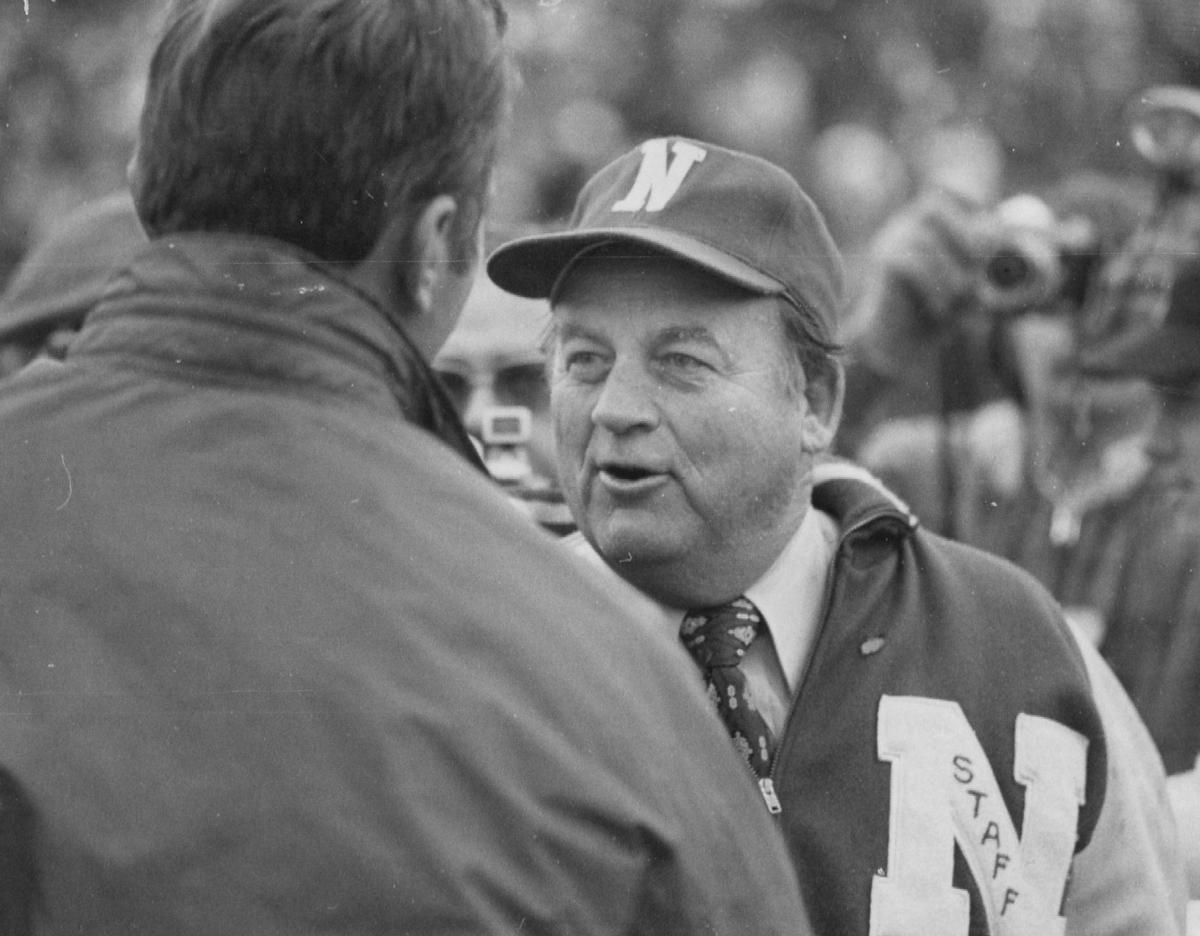
Nebraska coach Bob Devaney is congratulated after defeating Oklahoma 35-31 in the Game of the Century in Norman, Okla., on Nov. 25, 1971.
Journal Star archives
Prefer us on Google Learn More
The tone was set immediately with national championships in 1970 and ’71, and a win against Oklahoma in 1978 set the table for the next 20 years.
Greg Lederer, a lawyer in Cedar Rapids, Iowa, was a walk-on swimmer who came to Nebraska in 1969. His first year was spent in Abel Hall, living two doors down from two guys who would go on to become all-time Husker greats: Rich Glover and Daryl White.
Lederer led a charmed existence as a Husker football fan in those days, seeing just two home losses in four seasons: the 1969 season opener against USC and the 1972 regular-season finale against Oklahoma. He also was in the stands for one of the program's greatest triumphs: Nebraska's 38-6 win over Alabama in the 1972 Orange Bowl.
Football
This fall's Special Section is a salute to Nebraska football fans. Take a (digital) stroll through it
- Lincoln Journal Star
Summing up the era
"It was idyllic. We expected to win every game. The football games were the focus of virtually all life on campus. I really didn’t know people who didn’t go to the games. I’m sure there were plenty of them, I just didn’t know them.
People are also reading…
- How to watch Nebraska volleyball vs. Northwestern today
- Lincoln teen killed in crash at 84th and O streets
- What does it take to beat Nebraska volleyball? Wisconsin’s coach has an answer
- Sydney Loofe's family to share their story for the first time in new Hulu documentary
- Ricketts defends pardon of man convicted of sexually assaulting estranged wife
- Doane student killed in Texas in attempted murder-suicide
- Lincoln teen accused of threatening school resource officer arrested at gunpoint
- Just: We are all tired. And the whys keep coming in Nebraska's latest soul-crusher
- NBA's Dwyane Wade is weighing in on this Lancaster County race
- Why an NBA great is wading into the Lancaster County sheriff's race
- 'Much respect to him': Nebraska reunion with Dylan Raiola short-lived — and painful
- Banana Ball 2027 to bring dancing and trick-play baseball back to Nebraska
- Husker Report Card: Grading Nebraska's performance at Oregon
- Nebraska Athletics sets 2027 Husker football season ticket prices
- Nebraska's Elk Creek mine project moves closer to $840 million federal loan
"Football players were kind of special, and were kind of looked at in awe."
Lederer then shared a story. Once, at a college party, he was mistaken for Nebraska quarterback David Humm. Years later, when Humm was diagnosed with multiple sclerosis, Lederer donated to a fund established by the Nebraska Greats Foundation to help with Humm's medical expenses, and shared the story with his donation. Days later, Lederer received a call at his office: it was Humm. The two talked for an hour despite hardly knowing each other.
"That to me, that’s what Nebraska was about back then. (And) it was Rich and Daryl just being regular guys. Two of the nicest guys that I met in college turned into just absolute beasts on Saturday."
Era-defining Huskers
"Rich Glover to me was the guy that kind of represents what Nebraska football was back then. Because he was incredibly good at his job. You never saw Rich act out on the field, you never saw Rich act out away from the field. He was the ultimate team player; you literally never heard him do anything wrong.
"And he was a weird size for his position, and yet he just destroyed people. If you go back and look at the Game of the Century, he was lined up against (Oklahoma center) Tom Brahaney, who was an All-American. And Rich dominated that game. He was getting double-teamed, and he still made like 24 tackles, or something like that. It’s a crazy number (it was actually 22 tackles).
"Jeff Kinne, Jerry Tagge, obviously (Johnny) Rodgers, just so many different kinds of people who played their roles as teammates. I just think that was an interesting collection of players. Aside from Rich, it’s really hard for me to pick out one particular player. Because it was such a team effort. That team did not generate a lot of NFL players. And I always thought that meant (Bob) Devaney and his staff took a bunch of really good, but not great players, and turned them into a dominant player."
Nebraska defensive tackle Rich Glover makes a tackle against Oklahoma in the Game of the Century in 1971.
Journal Star file photo
Era-defining moment
"In the lead-up to the Orange Bowl for the ’71 season, so it’s a Jan. 1, 1972, game, all the talk was about Johnny Musso (Alabama’s star running back). And the chant from Alabama and the national media was, 'See Johnny Run, See Johnny Run.' And as soon as the game started, it was apparent that it was the wrong Johnny. And the Nebraska side of the stadium was chanting 'See Johnny Run' every time Rodgers did something in the game.
"Nebraskans kind of have a little bit of a chip on their shoulder, because they perceive disrespect from national whatever. And that moment strikes me as representative of Nebraska’s way of asserting itself, is using somebody else’s chant and turning it around on them."
Nebraska's Johnny Rodgers celebrates with teammates after his 72-yard punt return in the Game of the Century against Oklahoma on Nov. 25, 1971.
Oh, the heartbreak
It's tough to find a heartbreaking moment when you win two national titles and dominate most of a decade, so Lederer went a few years ahead.
"Oh hell, that’s easy. That’s (Tom) Osborne going for two (in the 1984 Orange Bowl against Miami). Obviously I will always believe that was the right thing to do. But it cost us a national championship. But it was the right thing to do."
Era-defining team
"I thought it was a big deal that we went out to L.A. and played (USC) in the Coliseum and played them to a tie at the beginning of the ’70 season. We ended the ’69 season very well. That team is one of those teams that got better as the year went on. And you came away from the ’69 season with an awful lot of, ‘OK, maybe we’re coming back now.’ And to go out to SC and — that was a really good SC team — and to play them to a tie, was, I thought, a big deal."
Describe Memorial Stadium during this era
"That’s an interesting question. I was at the Hail Mary game with Northwestern (in 2013), and I was at the Miami game in 2014 when Ameer (Abdullah) basically dominated them. The Miami game is, for me, the wildest that Memorial Stadium has ever been. That crowd wanted blood that night. And it’s because it was Miami. And they lived up to our expectation in terms of behavior.
"I have no memory of Memorial Stadium ever being like that when I was in college." Then Lederer chuckles. "But honestly, there weren’t many games in my four-and-a-half years there that were all that exciting. We were so dominant that we just expected to win, we went to the game, we cheered the team. But it was a different time then. The noise for the sake of noise wasn’t really what the people were about. I mean, everyone was excited to let go of their balloons; I’m pretty sure we were doing that back then. The unfortunate tradition back then was, people threw oranges. And that was our definition of bad behavior."
The radio voice you came to love
"Well everybody talks about (Lyell) Bremser. I didn’t really pay much attention to those kinds of things. I remember growing up we would go pheasant hunting in the fall, but we’d stop for lunch and listen to the game. And I couldn’t tell you who we listened to."
Those damn …
"Well it’s always Oklahoma. That was the team that you felt like you were never safe. Hey, those were incredible football teams. You think back, and you look at today’s game, and you see how much focus there is on error, in terms of turnovers — Oklahoma didn’t give a crap about fumbles. They didn’t care! Because next time they get the ball, they’re going to house it.
"You go back and look at those stats, and it’s just phenomenal what those people could do. They had a collection of athletes that were simply undeniable. And it’s one of the reasons that I think what happened in the Game of the Century is so remarkable. We basically took away the pitch; we almost lost the game on what they never did, which was pass; but it worked.
"And then, of course, it was like we sold our soul. Because from then on, we had trouble with Oklahoma forever. And everybody can recount all the games that we should have won, and they somehow stole the game, and did so with a giddy level of confidence. They just knew they were going to win the game. And then we finally beat them (in 1978), and then what happens? We get to play them again in the Orange Bowl (where Oklahoma won 31-24). That can only happen to Nebraska."
Contact the writer at cbasnett@journalstar.com or 402-473-7436. On Twitter @HuskerExtraCB.

Chris Basnett
Assistant sports editor/high schools
Close
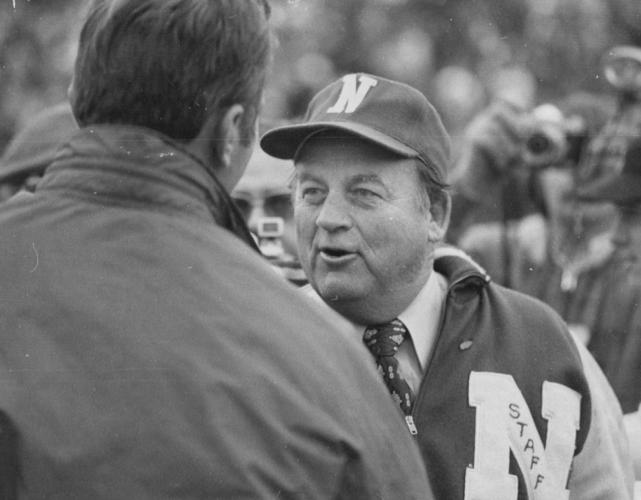
Nebraska coach Bob Devaney is congratulated after defeating Oklahoma 35-31 in the Game of the Century in Norman, Okla., on Nov. 25, 1971.
- Journal Star archives
Nebraska defensive tackle Rich Glover makes a tackle against Oklahoma in the Game of the Century in 1971.
- Journal Star file photo
Nebraska's Johnny Rodgers celebrates with teammates after his 72-yard punt return in the Game of the Century against Oklahoma on Nov. 25, 1971.
- Julie Koch